



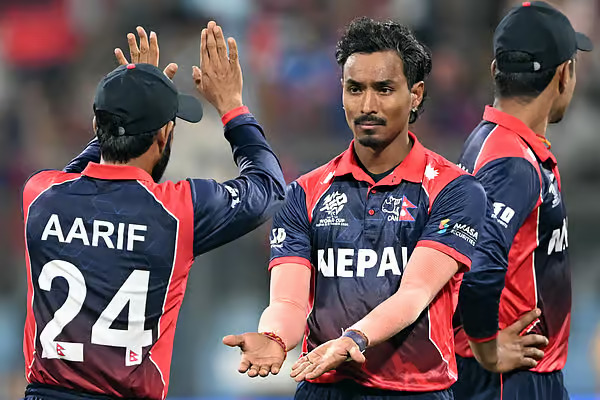
Nepal is increasingly being viewed as one of cricket’s most promising Associate nations, with the International Cricket Council (ICC) believing the Himalayan country could eventually follow the path of Afghanistan and earn a place among the sport’s Test-playing nations.
With a population of around 30 million, Nepal has developed a passionate cricket culture, a growing pool of elite players and an expanding domestic competition structure.
ICC Sees Huge Potential in Nepal
ICC Chief Executive Sanjog Gupta said Nepal has the potential to become the next major Associate nation to break into the top level of international cricket.
“They could be tomorrow’s Afghanistan, or tomorrow’s New Zealand for that matter,” Gupta told Reuters.
He highlighted Nepal’s growing pool of elite players, noting that the country is increasingly competing at major ICC events and demonstrating that it belongs on the global stage.
Gupta said Nepal’s potential is driven less by commercial value and more by its rapidly improving performances and enormous fan base.
Passionate Fans Driving Cricket’s Growth
Cricket enjoys extraordinary popularity in Nepal, where international matches often generate huge public interest.
The ICC has invested nearly $5 million in Nepal’s cricket development over the past two years and has also awarded the country co-hosting rights for next year’s Under-19 Women’s World Cup.
Gupta recalled the sight of thousands of Nepal supporters at Mumbai’s Wankhede Stadium during the 2026 T20 World Cup, describing it as one of his personal highlights of the tournament.
Nepal defeated Scotland by seven wickets in that tournament to secure its first victory at the global event since 2014.
2014 T20 World Cup Changed Nepal Cricket
Nepal’s qualification for the T20 World Cup in 2014 marked a major turning point for the sport.
Playing in a region dominated by cricketing giants such as India, Pakistan and Sri Lanka, Nepal suddenly had a team capable of competing on the international stage.
The country gained One-Day International status in 2018, further accelerating cricket’s popularity.
Former Nepal captain and Cricket Association of Nepal secretary Paras Khadka said the progress helped cricket become the country’s favourite sport and created a strong sense of national pride.
Nepal Premier League Adds Commercial Strength
The Nepal Premier League (NPL) has also become an important part of the country’s cricket development.
After two seasons, the domestic T20 competition has generated valuable revenue and provided a stronger commercial foundation for the sport.
Khadka described the NPL as a pivotal part of Nepal’s cricket growth, saying revenue from the tournament is being reinvested into cricket.
The league could eventually provide the financial stability needed to expand player development programmes and cricket infrastructure.
Strong Performances Still Essential
Despite the enthusiasm surrounding the sport, Khadka believes Nepal must continue producing strong results to maintain public interest.
He stressed that passion alone cannot sustain cricket and that consistent performances against high-quality opposition are essential for the team’s development.
Nepal has already demonstrated its ability to challenge stronger sides in T20 cricket, coming close to upsetting England and South Africa at the 2026 World Cup in India.
Nepal Wants More Matches Against Test Nations
Greater exposure against top teams is now a major priority for Nepal.
Khadka said the country is in discussions about arranging bilateral series against Test-playing nations, which would give Nepal’s players valuable experience against higher-ranked opposition.
The Cricket Association of Nepal has also introduced contracts for both men’s and women’s players, expanded red-ball cricket and continued efforts to improve infrastructure.
Afghanistan Provides a Blueprint
Nepal sees Afghanistan’s rise as an example of what an Associate nation can achieve.
Afghanistan developed rapidly from its Associate status, became increasingly competitive in limited-overs cricket and eventually gained Test status in 2017.
Khadka believes Nepal can learn from that journey.
“There’s a blueprint for sure,” he said, adding that Nepal would like to follow a similar path.
A Potential New Force in World Cricket
With a passionate fan base, a growing domestic league, increased investment and an improving player pool, Nepal appears to be entering an important phase of its cricketing development.
If the country can maintain its progress, improve infrastructure and regularly compete against stronger international teams, the Himalayan nation could emerge as one of the next major forces in world cricket.