



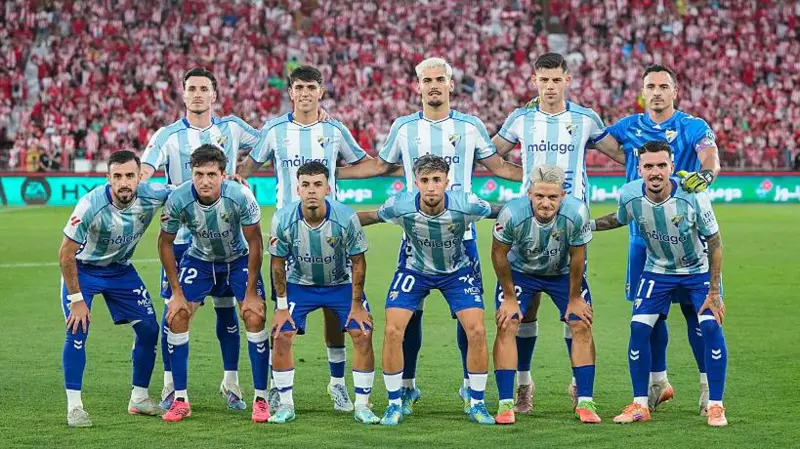
For Spanish football fans, the return of Malaga, Deportivo La Coruna and Racing Santander to La Liga is a welcome sight. All three clubs have enjoyed prominent spells in Spain’s top flight over the past three decades before financial and sporting troubles pushed them down the football pyramid.
Of the three, Malaga’s revival appeared the most unlikely. Just a decade after competing against Europe’s best in the Champions League, the Andalusian club was facing financial turmoil, ownership problems and an uncertain future.
Yet a young squad, an unconventional coach and unwavering support from the Malaga faithful have helped the club complete a remarkable journey back to Spain’s top division.
From Champions League Dreams to Crisis
On 9 April 2013, Malaga were just minutes away from reaching the Champions League semi-finals. Leading Borussia Dortmund 2-1 in the second leg of their quarter-final, the Spanish side appeared set to make history.
However, Dortmund scored twice in stoppage time to eliminate Malaga in heartbreaking fashion.
The result was still a remarkable achievement for a club that had only recently emerged as a major force in Spanish football.
In 2010, Qatari Sheikh Abdullah bin Nasser Al Thani bought Malaga and invested heavily in transforming the traditionally second-tier club into a European contender.
The Rise of a European Contender
Under manager Manuel Pellegrini, Malaga assembled an impressive squad featuring players such as Santi Cazorla, Jeremy Toulalan, Ruud van Nistelrooy and Isco.
The club’s ambitions appeared limitless, but the project quickly began to unravel.
Pellegrini left for Manchester City, while Isco joined Real Madrid in the summer of 2013. Soon after, Malaga were banned from the Europa League for breaching UEFA’s financial fair play regulations over overdue payments.
Mounting debts forced the club to sell key players, while relegation from La Liga followed in 2018.
Ownership Problems Deepen the Crisis
Malaga’s financial difficulties continued to worsen. In 2020, a regional court ordered Al-Thani’s removal following allegations of financial mismanagement.
Court-appointed administrator Jose Maria Munoz subsequently took control of the club’s operations.
Malaga relied heavily on free transfers and loan deals as the club attempted to stabilise its finances. But the sporting decline continued.
In 2023, Malaga suffered another devastating blow when they were relegated to Spain’s regionalised third tier.
Escaping “The Well”
Spain’s third division is known as “El Pozo” — the well, reflecting how difficult it is for clubs to escape.
With fears growing that Malaga could disappear from professional football, a group of local businessmen even discussed creating a phoenix club should the situation deteriorate further.
Instead, Malaga’s young players delivered an immediate response.
A squad featuring academy graduates and local talents secured promotion at the first attempt. After finishing third in the southern section, Malaga faced Gimnastic Tarragona in a two-legged play-off final.
Antonio Cordero’s Promotion-Winning Moment
The decisive moment came deep into extra time of the second leg.
With Gimnastic on top, Antonio Cordero bundled the ball into the net, sending the travelling Malaga supporters into wild celebrations.
The goal secured Malaga’s return to the second tier and reignited the city’s passion for its football club.
The promotion was about more than football. It helped reconnect Malaga with its supporters and restored a sense of identity around the club.
Juan Francisco Funes Changes Everything
After promotion, manager Sergio Pellicer guided Malaga to a 16th-place finish in the second division.
However, the following season began poorly, with Malaga winning just four of their opening 14 matches.
Pellicer was replaced by reserve-team coach Juan Francisco Funes, an unconventional appointment who had never played or coached professional football.
Just weeks earlier, Funes had been considering a return to teaching after his team struggled at the bottom of the fourth division.
But his appointment proved to be a turning point.
The “Funesbuque” Revolution
Funes initially guided Malaga to one win and two draws before the team went on a remarkable six-match winning run.
The results improved, but so did Malaga’s style of football. The team began playing with greater attacking freedom and confidence.
Funes already knew many of the young players from his time with the academy. That familiarity helped him understand their personalities, strengths and weaknesses.
Among the players who became central to the revival were academy graduates such as Chupe, David Larrubia and Diego Murillo.
Chupe enjoyed a particularly impressive campaign, scoring 25 goals.
A Coach Inspired by Films and Teaching
Funes used his background as a teacher to motivate his players, drawing inspiration from historical figures, famous quotes and films.
His unconventional methods even included references to Kung Fu Panda as he attempted to communicate his football philosophy to the squad.
The players quickly embraced his ideas.
Funes affectionately referred to his players as “los bichos”, a colloquial term for talented people, which soon became one of the team’s nicknames.
Another nickname also emerged: “Funesbuque” — the good ship Funes.
A Play-Off Battle Against Almeria
After finishing fourth, Malaga’s promotion hopes came down to a play-off final against Almeria.
The financial disparity between the clubs was enormous. Malaga had one of the smallest budgets in the division and had spent only around £325,000 on permanent transfers since 2020.
Almeria, meanwhile, had spent more than £10 million during that season alone.
The first leg at La Rosaleda ended goalless, setting up a decisive second leg in Almeria.
Fans and Players United
Ahead of the crucial away match, hundreds of Malaga supporters lined motorway bridges to wave the team bus goodbye.
Such scenes had become increasingly common during the campaign, with supporters gathering outside the stadium with flags, songs and pyrotechnics.
The club’s Fondo Sur ultras adopted “Es la Vida Loca” — “the crazy life” as the soundtrack of the season.
The connection between the players and supporters became one of Malaga’s biggest strengths.
Chupe and Larrubia Deliver Promotion
In the decisive second leg, Chupe put Malaga ahead before David Larrubia produced a stunning finish to double the advantage.
Almeria pulled one goal back, but Malaga held on for a 2-1 victory and secured their return to La Liga.
The triumph sparked enormous celebrations across the city.
In a remarkable gesture, kit supplier Hummel had incorporated the names of all 26,550 season-ticket holders into a special shirt for the occasion.
185,000 Fans Celebrate Malaga’s Return
The promotion celebrations continued throughout the weekend, with an estimated 185,000 supporters taking to the streets of Malaga to welcome their heroes home.
For many young supporters, the moment carried special significance.
They had grown up after Malaga’s Champions League era and knew the club primarily through years of financial problems, relegation and uncertainty.
The return to La Liga therefore represented the end of a difficult chapter.
A Special Bond Between the Team and Supporters
The relationship between Malaga’s players and supporters became even more evident after promotion.
Several players challenged fans on social media to meet them early on a Monday morning at a roundabout on the western side of the city.
Hundreds of supporters turned up.
That extraordinary connection reflected a wider feeling around the club — that the team, supporters and city were finally moving in the same direction.
Preparing for Life Back in La Liga
Despite their promotion, Malaga’s preparations for their return to the top flight have been relatively modest.
Several key players have renewed their contracts, while sporting director Loren Juarros has focused on smart loan deals rather than expensive transfers.
Promotion winner Carlos Dotor returned on loan from Celta Vigo, while winger Juan Cruz joined from Leganes on loan.
Given their limited financial resources, Malaga are widely expected to face a difficult battle against relegation.
A New Chapter Begins
Malaga’s return to La Liga begins with daunting fixtures against Atletico Madrid and Real Madrid.
But after everything the club has endured, simply returning to Spain’s top flight is already a remarkable achievement.
From Champions League nights and financial collapse to the third division and finally promotion, Malaga’s journey has been filled with setbacks, unlikely heroes and extraordinary support.
For a new generation of Malaguistas, the club’s return to La Liga offers something they have waited years to experience — the chance to dream again.